

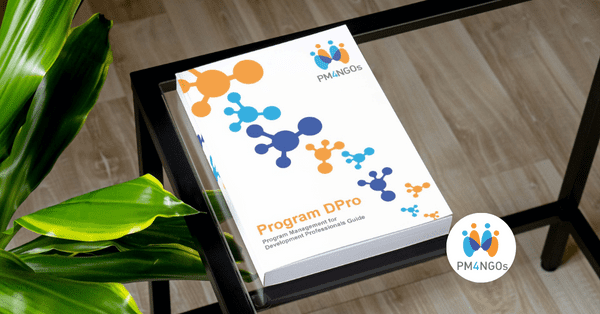
PM4NGOs is developing the Program Management for Development Professionals Guide to provide advice, tools and guidance to help Program Managers work effectively at a pivotal level in local, national and international NGOs.
Program managers play an essential role by providing an interface between their organization’s strategic management team and project managers who are accountable for the successful delivery of small, medium, and large projects.
The Guide is expected to be launched in the first semester of 2016. However, we would like to anticipate discussion about this new approach and to gather feedback from the PM4NGOs community in advance by sharing our new Program Lifecycle diagram and approach.

PROGRAM PHASES
 Program Identification
The initial ideas phase when key stakeholders, together with beneficiaries, outline the basic needs and gaps in services or opportunities in target communities. High-level goals and outcomes are identified and these can then be turned into tangible concepts for which funding and buy-in is then sought.
 Program Design
The program foundations are built through solid design and integrated mapping of each of the diverse elements of the program. This is the framework through which Program Managers can control, monitor, and execute all components associated with program implementation. Repeating this phase several times over the lifecycle of a program is the best way to ensure continued relevance and impact.
 Program Planning and Implementation
Assuming that the program is funded and the initial design is complete, it is now time to start the program planning and implementation. Program Managers invest time in translating the design into more accurate plans: managing and leading different teams, engaging key stakeholders, responding to challenges and risks (known and unknown) of multiple projects, and overseeing internal controls. Like the Program Design phase, this process is also iterative, with each phase complementing the other, resulting in programs that that are targeted and reflective of changing environments.
 Program Closure
Programs should come to a natural end, closing when all of their constituent projects are completed and benefits realized and accepted by stakeholders. There should be a transition through which the implementing agency transfers responsibility of maintaining those benefits elsewhere.
Decision Gate
A Decision Gate captures the objective of each phase in the form of a question, prompting the Program Manager to check that all activities have been completed before moving onto the next phase. For example, the Decision Gate between the Identification and the first Design phase is: Do we design? Do we have all of the information that we need to move forward into the next phase? Decision Gates are powerful tools for Program Managers who have the big picture overview to ensure that multiple projects move into different phases so as to achieve the overall program goal.
PROGRAM PRINCIPLES
The Program Lifecycle Diagram shows five essential principals that cut across all program phases and should be applied skillfully at program and project levels. As the diagram indicates, all programs must be: Well governed, Participatory, Comprehensive, Integrated and Adaptive. Each of the five principles should be applied together, throughout the life of a program.

Well governed
Good governance defines the management framework within which program decisions are made. It is essential to a program’s success and should be emphasized at each phase of the program life cycle. This necessitates establishing program governance structure defining the roles, responsibilities, authority, and accountability for each component of the program.
Participatory
An excellent program is inclusive and Program Managers should seek the perspectives of a variety of stakeholders in all program phases. This ensures that program implementation reflects the current context and the true capacities and inclinations of all those involved.
Comprehensive
A good program plan needs to demonstrate a thorough understanding of how each of the component parts (projects) fit together to create a greater whole. It is also an opportunity to show how each of the elements combine to provide the leverage and added value gained as a result of working in an integrated way.
Integrated
Processes should be aligned and coordinated through all phases in the life of a program, with each of the component parts combining effectively to operate smoothly as a whole.
Adaptive
The Program Manager should ensure that management processes are revisited and repeated through the life of a program to check that designs and plans are still relevant to improve efficiencies and allow adjustments to be made to keep a program on track.
 What happened with the monitoring and evaluation?
When a program is underway and project teams are focused on the implementation of activities and operations, it’s easy to lose track of the big picture. The Program Manager needs to ensure that the work of their project teams remains aligned with the program vision and plan, and this necessitates building in processes to monitor output standards and gather feedback about performance.
Working in this way is invaluable for highlighting potential problems and making course corrections, and if done regularly throughout the lifecycle of a program, provides the insight needed to deliver excellent and informed evaluations that inform future programs and meet the requirements of donors.
Monitoring and evaluation are critical processes that cut across all phases, and are systematically and intuitively built into the entire lifecycle of a program rather that at specific moments or milestones. Rather than identifying these elements within the program phases, or as representing a specific moment, our approach is to ensure that the tools and disciplines of monitoring and evaluation are built in as a core element of each of the principals as a permanent and consistent component of program management.
Your views are important. We would like to hear from Program or Project Managers in the PM4NGOs community to find out what you think about this approach.
Does the Program Lifecycle Diagram work for you?
What do you think about the definitions of its phases and principles?
We are in the process of shaping this into our new Guide and your feedback and suggestions would be great at this stage. So do get in touch.
Post your suggestions and feedback below or send it through our contact form.
I understand the logic behind taking out the M&E part from the traditional 5-phased full cycle. The fact tat the traditional cycle has shown M&E towards the end had misleading message that M&E happens only towards the end. One attempt to address this challenge was to draw arrows starting from the M&E stages feeding-back to planning and implementation, in an effort to show that M&E is linked to other stages in the cycle.
While I like your logic, I still doubt if taking it out altogether from the cycle is the best option. M&E should somehow be indicated in the cycle you propose. My suggestion is to draw a line going around the proposed cycle, and show that M&E is there linked to all phases. We need to see it to remember that it is part and parcel of the whole program/project management cycle.
One more issue that kept coming up when a project cycle is discussed is that the once a project/program management went through the full cycle, it is in a higher position of designing a better project from the lessons and experience of implementing the previous one, and hence a “full round cycle” is not a good representation of an improved project design capability. A spiral, which puts the new project design at a higher position than the previous project design was, is a good presentation of this logic.
Dear Beruk K. Negash,
Thank you for sharing your thoughts and suggestions! We will definitly take it in consideration when revising the diagram, which will happen in a few weeks.
Kind regards.
I preseiate and Thankful for sharing this diagram with us . often new thoughts and suggestions looks like strange! but really in this case i can’t imagine if we can omit M & E , It’s important and critical points, I will do my best to revising the diagram.
Thank you for sharing us this. Omitting M&E phase may indicate that it (M&E) is done through all the other phases, but I think it is important to show this in one way or another, for instance, using a color as a background for all phases, or use symbols like for the Decision Gates.
Thank you
Dear Ahmed,
Thank you for sharing your thoughts and suggestions!
Kind regards.
People sometimes have difficulties understanding how programs and project complement each other and how to envision the various elements of a systematic approach at the different levels. Thus a discussion of the relationship between project, program, and portfolio management would be helpful. That way we can see how it all can function from the strategic to the functional, and also how project management focuses more on the implementation whereas program management on how project contribute to achievement of higher level objectives
Also programs are usually managed in a more centralized manner as they aim to coordinate a group of projects to achieve the program’s strategic objectives.. Thus this could be shown.
Dear Freddy,
Thank you for sharing your thoughts and suggestions!
Kind regards.
I know that you have to keep the diagram as simple as possible. However, representing projects by a line may imply that projects are linear processes which they definitely are not.
I would represent the projects with circular arrows: some of them might be single like a circle. Others might overlap with other projects and Some might feed into another project.
A bit like the Olympic rings but not closed.
I’m not 100% sure about the representation, but I think it might be a good idea to show that projects are not linear and that they can overlap our feed into one another in a programme
Dear Kamal,
Thank you for sharing your thoughts and suggestions!
I really like the idea of representing the projects not as an single line. We will take your suggestion to our team!
Kind regards.
Thank you for your effort to develop this guide .. really it is very good work you do.
I suggest only to add monitoring and evaluation to PROGRAM PRINCIPLES because it is Continuous process through the program to evaluate Objectives and outputs for projects.
Dear M Kayes,
Thank you for your contribution. We are collecting all comments and sending to the specialists that are developing the Program Guide. They will take in consideration your comments.
Thank you again!
As a Monitoring and Evaluation professional, more than a Project Manager, I think the idea to treat monitoring and evaluation as cross-cutting themes has some considerable merit.
I am currently doing a PhD looking at monitoring practice in development projects. I note a few more recent articles on monitoring and evaluation have started to use the term ‘function’ rather as a ‘phase’. I think ‘function’ is a pragmatic term for monitoring, and evaluations rather than a phase, which is too linear and sequential in terms of complexity theories.
I assume there will be some content guide on monitoring and evaluation in the new guide. If so, a sincere and passionate request for monitoring and evaluation are treated as two distinct, yet complementary, functions. Too much literature blurs these two functions together by using the very poor (if not lazy) term of “monitoring and evaluation” (or, even worse, the abbreviation, M&E). When the composite term is used, inevitably, evaluation gets a greater amount of content and coverage. The clear identification and distinction of what monitoring is, is very important for implementation phase of the project lifecycle.
Look forward to seeing the new Guide when it is released.
Dear Murray,
Thank you for your comments. We really liked that a M&E specialist consider a good approach that the Program Guide innovation on how M&E is presented.
We expect to launch the Guide this year. A draft version might be ready in the next few months.
Thank you again
please can some one help me. i want to take the PMD pro certification but i have been going through the site but cant really get a clear way forward.thank you
Dear Ateh
Thank you for your contact.
PM4NGOs is the guardian of PMD Pro and other methodologies. We are also a platform to connect professionals and PMD Pro training organizations and, for that reason, we do not develop training courses.
All learning material (guides) are available for free at the PM4NGOs website, in several different languages:
http://www.pm4ngos.com/the-guide-to-the-pmd-pro/
Please check on the Training Organizations page to find a nearest training organization. We would like to ask you to contact them directly. They will be able to enroll you in a training course and apply the certification exam at its completion.
• http://www.pm4ngos.com/cm-business-directory/
You might also be interested in the Self Study Site (http://projectservices.lingos.org/pmdpro1-self-study-site/ ) and the Last Mile Learning (http://pilot.lastmilelearning.org/index.php?lang=en ).
If you take the Self Study pathway, then you will have to take the certification exam at its completion. Please visit APMG, our partner and independent accrediting organization that provides the exam.
• http://www.apmg-exams.com/index.aspx?subid=38&masterid=10
Finally, if you are not a member of our community yet, join us for free: http://www.pm4ngos.com/join-us/pmdpros/
Please do not hesitate to contact us if you have any further question.