

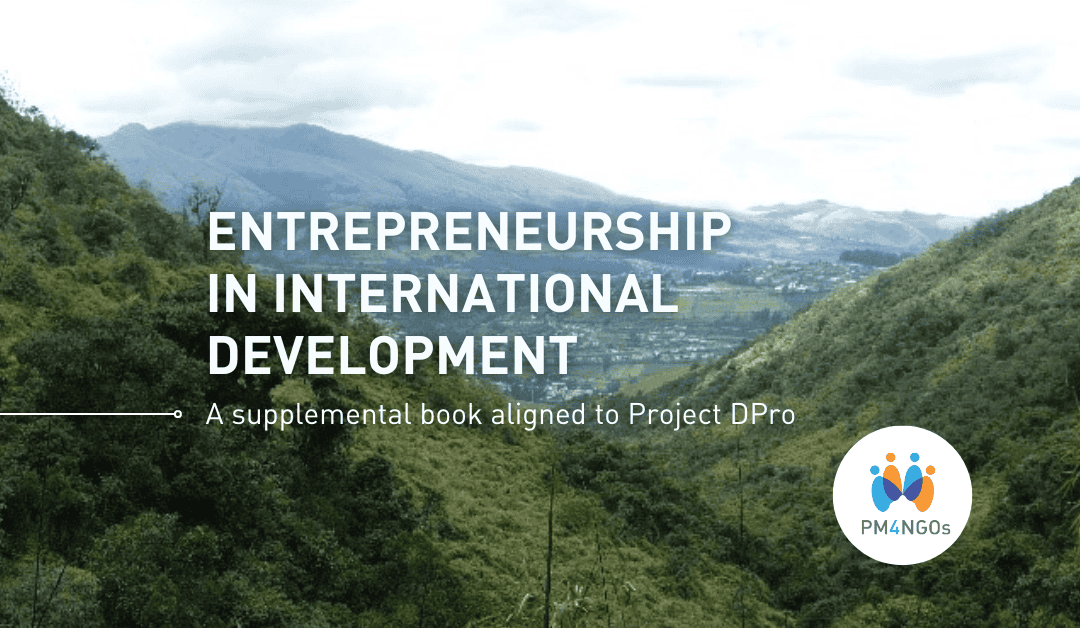

The Ecuadorian Andes: Home to the many entrepreneurial initiatives discussed in this article
The need for an approach to manage Entrepreneurial projects
When I arrived in Ecuador in 2007, it was with the aim of researching the management of projects in the international development sector. At that time, PM4NGOs and PMD Pro did not exist.
During my research, I identified the need to create a standardized methodology for the management of development projects. PMD Pro, later to become Project DPro, addressed this need soon after. Nevertheless, another aspect of my research remained unresolved.
The projects and initiatives I was introduced to and became familiar with were all ones aimed at increasing incomes of local people. These included a milk cooperative in the province of Tungurahua, a community tourism venture in a rural parish of capital city Quito, an attempt to foster economic development in the cloud forest town of Pacto, and a food production initiative in the mountain province of Cotopaxi.
All of these projects were run and funded initially by International NGOs, but had the goal of leaving productive processes in place to be managed autonomously by local people upon project completion. There are some factors making such entrepreneurial initiatives distinct from other development interventions. One of the foremost of these concerns the fact that, while other projects aim to foster local management of project deliverables once the project ends, a successful economic or entrepreneurial project leaves local people with the foundation for an ever more diverse production.
Take the milk cooperative in Tungurahua for example. An initial NGO-led project, funded by the European Union, provided training to farmers on practices for increasing the quality of milk production and created a facility for the storage and processing of milk replete with all of the necessary machinery. This successful project enabled local farmers to attain higher prices for their products leaving them and the community cooperative with excess funds. The cooperative was then able to secure a loan from a national development bank for the production of dairy products.

Artisan products on display at a traditional Ecuadorian craft market
Similarly, the community tourism venture located in a rural parish on the equatorial line in the suburbs of capital city Quito was also initially an NGO-led project. The community organization at the project’s center received infrastructure deliverables such as a community-run restaurant for tourists and visitor cabins. Once again, local ownership after the project ended led to diversification and an increase in micro-enterprises in the local area. Both these examples demonstrate how networks of entrepreneurships flourish and expand in development settings leading on from an initial impetus.
In turn, the ability to raise funds through entrepreneurship can foster local investment in a wide array of projects and initiatives and, of course, can empower marginalized people through economic liberation. With relevance to the UN Development goals, aside from the obvious objective of Decent Work and Economic Growth, Entrepreneurship in Development can contribute to the achievement of goals such as Reduced Inequalities, Sustainable Communities and Responsible Consumption and Production.
For these reasons and more I have designed the book “Entrepreneurship in International Development”. This book is perfectly aligned with Project DPro but also functions as a standalone book. As with Project DPro, Entrepreneurship in International Development is process-based and guides practitioners and entrepreneurs through a four phase process for the development of entrepreneurial projects. The book also furnishes readers with an extensive array of tools for the development of business models and entrepreneurial ideas and a set of principles for the management of entrepreneurships in the development sector.
The Kindle version of Entrepreneurship in International Development by Oliver Carrick can be purchased at amazon.com.

ABOUT THE AUTHOR
Oliver Carrick
Oliver is a part-time consultant who contributes to PM4NGOs as the Learning and Quality Program Manager. He is a British academic, Project Manager, author and consultant living in Ecuador. He currently resides in the Galapagos islands where he is a Professor and department head, and also manages a program of community outreach projects.
Oliver holds a Bachelor’s degree in Management, an MSc in Project Management, and a PhD in International development. He is also PMD Pro Level 2 and Program DPro certified. Oliver is a PMP and a PRINCE2 Practitioner.
“Many years ago, I began my PhD in International Development with the aim of creating tools and methods to improve Project Management performance. PMD Pro represents the embodiment of all I have advocated over the past decade, and I am thrilled to be a part of the PM4NGOs team.”